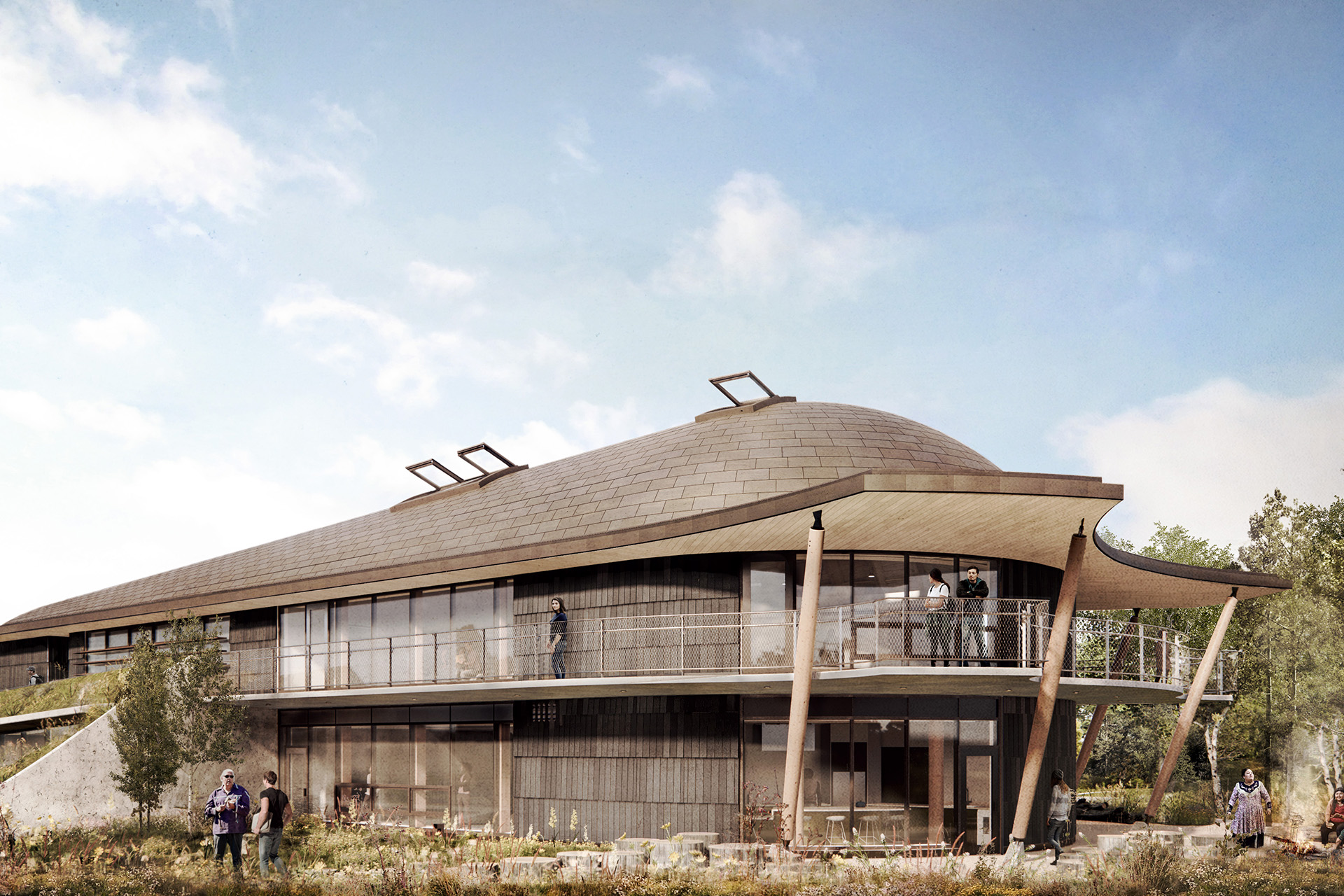
Indigenous House marks a profound shift at the University of Toronto Scarborough Campus, offering a humane and organic counterpoint to the campus’ Brutalist and modernist buildings. It establishes a place where Indigenous students, faculty, staff, and community members feel they belong, and affirms the University’s commitment to Canada’s Truth and Reconciliation Commission’s Calls to Action.
Collaboratively designed by Formline Architecture & Urbanism and LGA Architectural Partners, the building brings together academic and social spaces, offices for Elders and Indigenous staff, areas for research and language preservation, and spaces for exhibitions, classes, gatherings, and—crucially—for ceremonies previously unsupported on campus. Replacing a surface parking lot, the project draws from nature and Indigenous Ways of Knowing to shape a contemporary, regenerative building that restores the site with medicinal planting, passive heating and cooling strategies, and spaces that actively support Indigenous culture and traditions.
Inspired by a wigwam and Eastern Longhouse, the two-storey, ovoid-shaped structure expresses Indigeneity in both form and construction. A curving grid of glue-laminated timber recalls traditional bentwood techniques. Visitors ascend earth ramps planted with medicinal Indigenous plantings to balconies that overlook a large gathering space and long views of the Highland Creek Ravine. Inside, a clear plan places offices at the centre, bookended by round social and ceremonial spaces, all linked by an atrium that reinforces the building’s organic expression.
Traditional wigwam and longhouse principles also informed the building’s innovative environmental systems. Fresh air passes through a sculptural concrete ventilation totem intake and moves through earth tubes buried 2.7 metres below grade, using the earth’s constant geothermal temperature to preheat or cool air depending on the season to reduce energy loads. In contrast to typical university buildings, there are no smoke detectors, enabling smudging throughout and ensuring the building can fully accommodate cultural and ceremonial traditions.
In consultation with local Elders and in collaboration with Public Work, the surrounding landscape is planted with medicinal and native species—including a birch thicket and an outdoor gathering area—ensuring Indigenous House will mature into a natural, evolving heart of the Indigenous community and the broader campus.
Alfred Waugh, Matthew Hunter, Henry Dyck, Nik Langroudi
Consultants
Structural Engineer: Equilibrium Consulting Inc.
Mechanical Engineer: Integral Group
Electrical Engineer: Integral Group
Civil Engineer: MTE
Landscape: Public Work
Wayfinding: Adams + Associates
Foodservice: Kaizen
Code: LMDG
We use cookies to enhance your browsing experience and to analyze our traffic. By continuing to use our website, you consent to our use of cookies. For more information about how we use and store your information, please review our Privacy Policy.